Showing posts with label manila. Show all posts

Thursday, April 12, 2012

Quiapo Church, Binondo Church and Malate Church: Visita Iglesia Ten to Twelve

"Jesus is stripped of His garments."

Quiapo Church
Minor Basilica of the Black Nazarene
St. John the Baptist Parish
Quiapo, Manila
Founded in 1586, consecrated on 1988, The church is reputedly famous for enshrining the Black Nazarene, a dark statue of Jesus Christ which many faithful claim to have miraculous powers. Filipino artist and architect, Juan Nakpil also rebuilt the church after the 1928 fire.

The facade

The devotees outside waiting for the 3PM procession

A madman, being a prophet

The grandiosity

"Crucifixion: Jesus is nailed to the cross."


Binondo Church
Minor Basilica of St. Lorenzo Ruiz
Binondo, Manila
Founded by Dominican priests in 1596 and built in 1852 to serve their Chinese converts to Christianity. San Lorenzo Ruiz, who was born of a Chinese father and a Filipino mother, trained in this church and afterwards went as a missionary to Japan and was executed there for refusing to renounce his religion. San Lorenzo Ruiz was to be the Philippines' first saint and he was canonized in 1987.
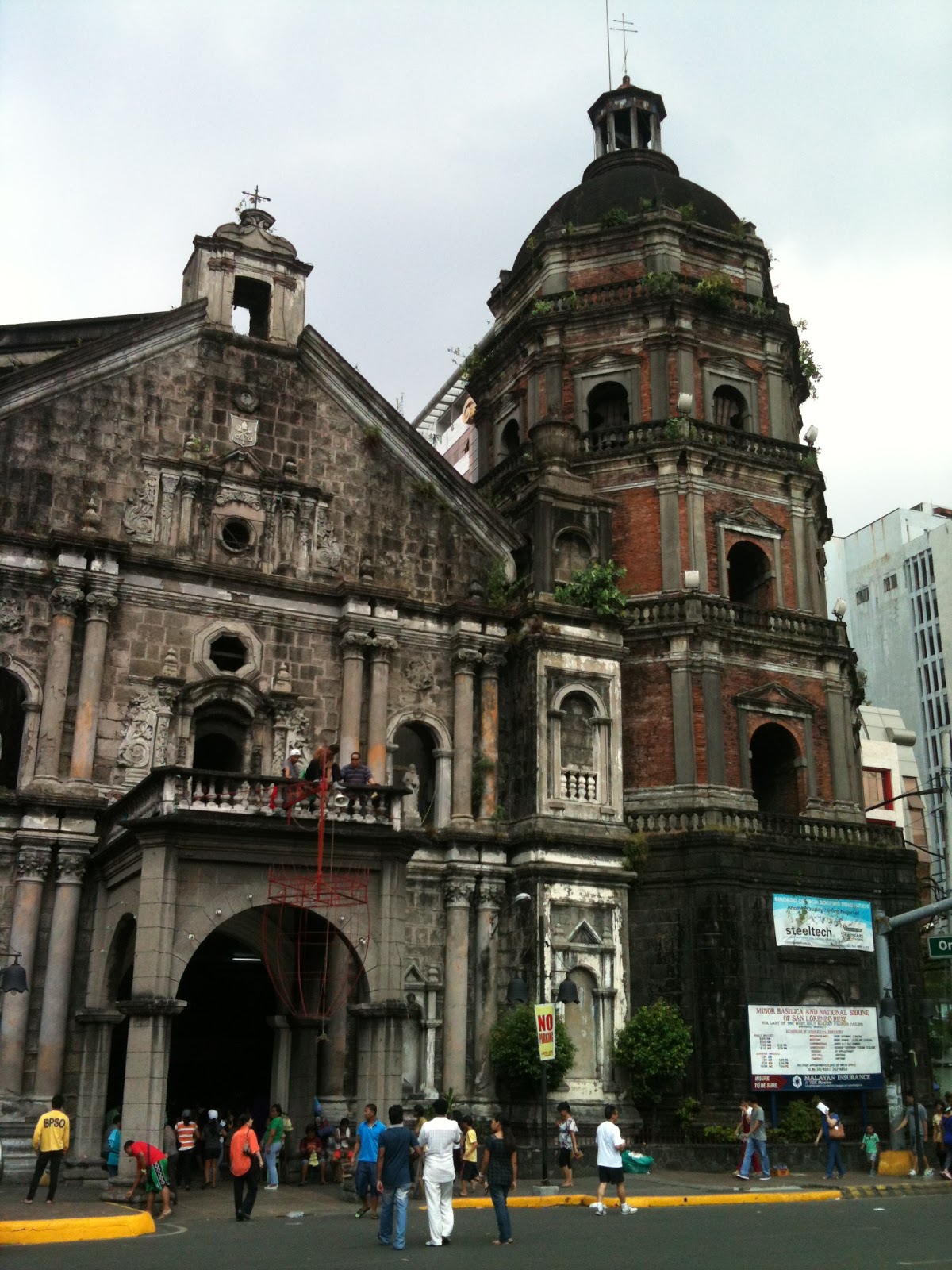
Western facade and the bellfry

An old statue

The ceiling, the altar and the aisle

Look at that dome!!!


"Jesus dies on the cross."


Malate Church
Our Lady of Remedies Parish

MH del Pilar, Malate, Manila
Originally built in the sixteenth century by the Augustinian friars. A Baroque-style church dedicated to Nuestra Senora de Remedios ("Our Lady of Remedies"), the patroness of childbirth. A revered statue of the Virgin Mary in her role as Our Lady of Remedies was brought from Spain in 1624 and stands at the altar.


The facade

In memory of...

The aisle

Intricate baroque

Next and last stops, Shrine of Jesus, Shrine of St. Therese and Santuario de San Antonio Parish.

Sunday, April 8, 2012

San Sebastián Church, St. Jude Church and San Beda Chapel: Visita Iglesia Three and Four

"Jesus falls for the first time."

San Sebastián Church
Basilica Minore de San Sebastián
Parish of San Sebastian and the National Shrine of Our Lady of Mt. Carmel
Plaza del Cármen, Claro M. Recto Street, Quiapo, Manila
Completed in 1891, noted for it's Gothic architectural design, pre-fabricated and for being the only all-steel church or basilica in Asia. In 2006, it was included in the Tentative List for possible designation as a World Heritage Site.

The facade in powder blue.

The twin spires!

The all-steel work is amazingly charming.

I just can't get enough of the grandiosity.

"Jesus meets His mother."

St. Jude Church
National Shrine of St. Jude Thaddeus
J.P. Laurel St., San Miguel, Manila
Completed in October 23, 1960, one of the three erected parishes for the Chinese/ Filipino-Chinese. Known for it's Thursday novenas.

Church's facade

Modern interior

San Beda Chapel
Abbey of Our Lady of Montserrat
San Beda College, Mendiola St., Manila
Built in 1925, it's titular patron is the Sto. Niño de Praga. The murals and paintings inside is most admired of the church.

The neo-Gothic facade
This Abbey does have a European feel

Beautiful, just beautiful.

Amazing paintings, almost Trompe-l'œil

Next stop, Our Lady of Mt. Carmel Parish Church and Morong Church.

Credits for San Sebastian Church info.
Credits for St. Jude Church info.
Credits for San Beda Chapel info.

Sto. Domingo Church and Santissimo Rosario Church: Visita Iglesia One and Two

Happy Easter everybody! Last month, my and my friends planned to have a holy week vacation in Puerto Galera, or probably to the more proximal Batangas beaches to relax and unwind. It was a much needed getaway since we seldom see each other these past few weeks due to busy work schedule. But how can one relax in a crowded beach where everybody wants to have fun and party at night. As traditional and conservative as it may seem, a Visita Iglesia (latin for Church Visit) is more apt. For those who doesn't know how that works, it is simply visiting one, seven or fourteen churches and praying the 14 stations of the cross, spread among the visited churches if 7 or 14.  Our original plan is to visit the Bulacan churches first thing in the morning on a Maundy Thursday, but we barely left northern Manila because the traffic is already thick. We headed back to Quezon City and had our first church.


"Jesus is condemned to death."

Sto. Domingo Parish Church
National Shrine of the Queen of the Holy Rosary
Quezon Ave., Quezon City
Founded in 1941 in Manila and 1951 in Quezon City. Houses the Marian image of La Naval.


The church's facade

An angel font

The alter and the aisle.

Stained glass depicting Christ's crucifiction.


"Jesus accepts the cross."

Santissimo Rosario Parish Church
University of Santo Tomas Chapel
University of Santo Thomas, Espana, Manila
Manila Archbishop Michael O’Doherty canonically inaugurated the UST Chapel into the Santisimo Rosario Church on April 26, 1942.


The church's facade.

Church bells in modern mounting.

Truly pontifical, Sancti Thomae Aquinatis.

Simple and solemn.

Sun marble pavement.

Next stop, San Sebastian Church, St. Jude Church and the Abbey of Our Lady of Montserrat.

Credits for Sto. Domingo Parish Church info.
Credits for Santissimo Rosario Parish Church info.

Thursday, June 23, 2011

Manila Cathedral: A Basilica for the Blessed Virgin Mary

The Philippine's rich history depicts not only independence but also the rise from a fall. A perfect example of this is the Manila Cathedral. This is the second, and last, place of worship that we visited on Independence day.

Formally known as the Manila Metropolitan Cathedral-Basilica or the Cathedral-Basilica of the Immaculate Conception, a Minor Basilica of the Roman Catholic Archdiocese of Manila located in Intramuros, Manila. Erected in 1954. Completed 1958. The cathedral's history dates back to 1581, 6 constructions, 1 typhoon, 1 fire, 4 earthquakes and 1 bombing. The old structures are destroyed but the church withstood the fall. The basilica is in Neo-Romanesque style.


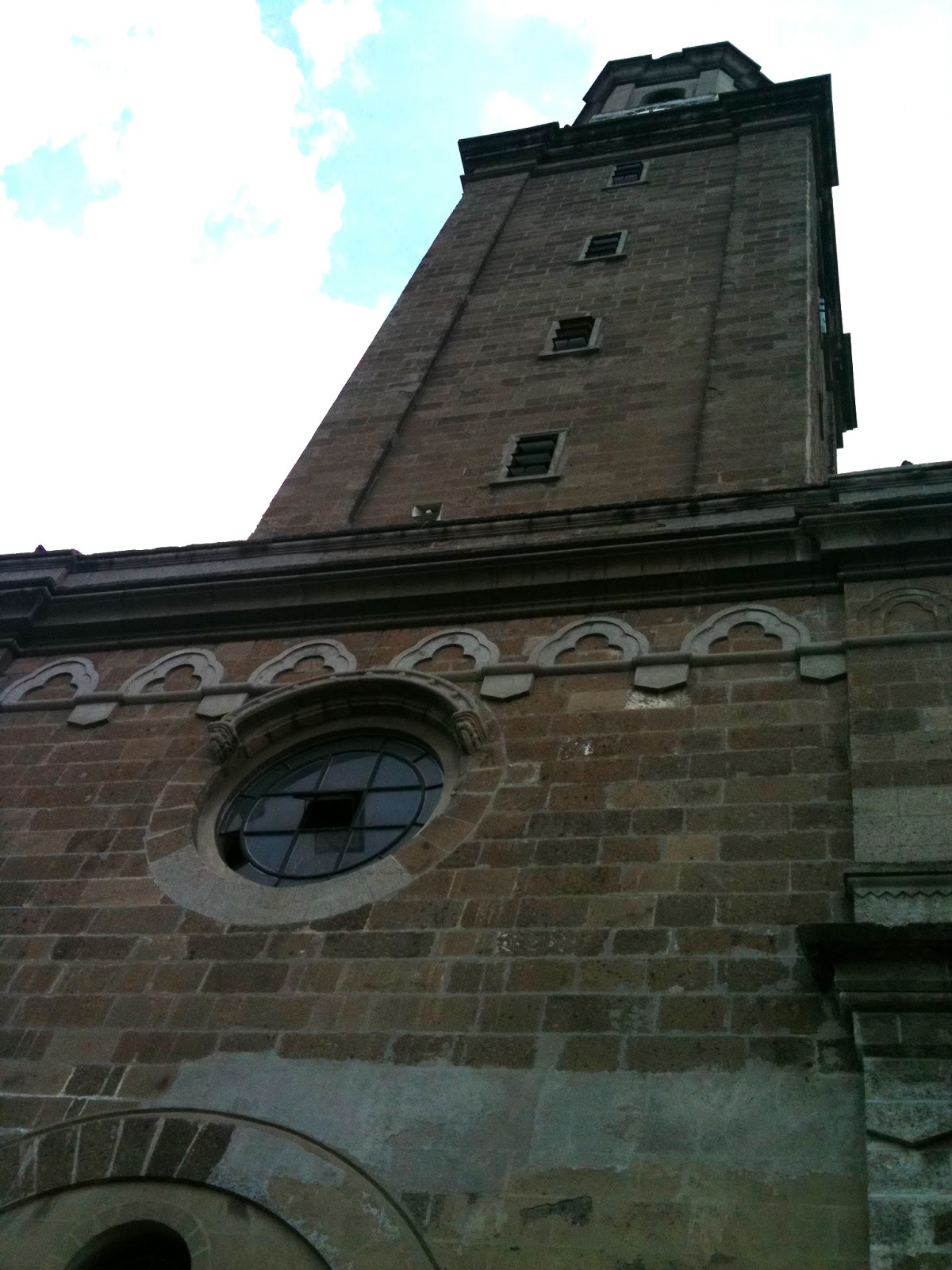
The tower in contrast

By Architect Fernando Ocampo

Famous saints sculpted in Roman travertine stones

A perfect venue for weddings

Inscriptions on the tympanum of the main door

The Portal by Italian A. Monteleone and F. Nagni

Stained glass by Galo Ocampo


Light seeping through the iron wrought grills

Rays of light over the bronze carvings on the church's main portal

Fray Juan de Uguccioni designed the Cathedral Dome (not in the photo)

The magnificent facade

Awesome structures like these, with historical value and cultural relevance are all over our archipelago. Visit one, you'll see, you'll be transported back in time and be amazed and proud!

San Agustin Church: Wedding Capital of the Philippines

The Philippine Independence Day (June 12th) brought back so many things apart form the history and culture of the Filipinos. It did brought us back in time, a blast from the past, courtesy of our very own world renowned places of worship. First of which is the UNESCO World Heritage site, designated in 1993 under Spanish colonial church classification, the San Agustin Church.

Founded by the Augustinian Friars (Order of Saint Augustine) in 1571. The beautiful Roman Catholic church, in baroque style, is located in Intramuros, Manila. Erected in 1586. Completed in 1607. Apart from being known as the "Wedding Capital of the Philippines", it is also known for it's museum that is open for the public, but for a fee.

Here are the pictures that I took during our travel.


The facade to die for


By Architect Juan Macias

The church and the museum

Charming contrasts

A Trompe-l'œil ceiling by Italian C. Alberoni and G. Dibella

The second, and last, church during our walk in Intramuros is the Manila Cathedral, until the next post!

Info credits: Wikipedia and San Agustin Church website